
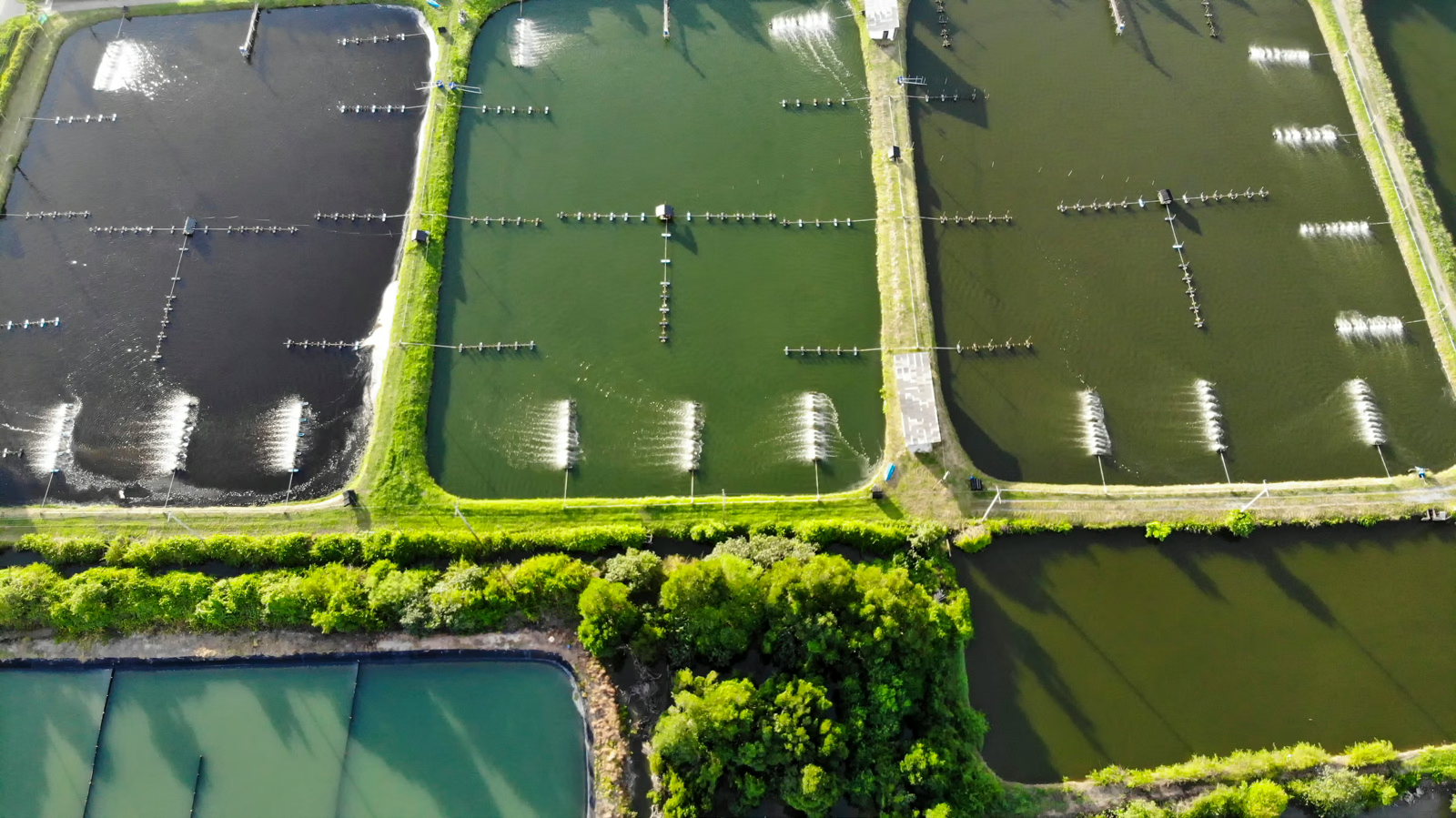
For decades, paddle wheels have been one of the most recognisable aeration tools in aquaculture. They are visible, familiar and simple to install. They churn the surface, move water across a pond and provide a basic level of oxygen support.
But surface agitation is not the same as efficient oxygen transfer.
As aquaculture systems become more intensive, the limitations of traditional aeration are becoming harder to ignore. Higher stocking densities, warmer water, organic loading and tighter water quality control all demand more than surface movement. Modern aquaculture needs oxygen that is transferred efficiently, distributed more evenly and held in the water column for longer.
That is where G-Cav™ changes the conversation.
Why Paddle Wheels Are Still Used in Aquaculture
Paddle wheels remain common because they are easy to understand. They physically disturb the water surface, increase surface contact with air and create visible circulation. In shallow ponds or low-intensity systems, that can provide a basic level of aeration.
The problem is that most of the visible energy is mechanical turbulence, not necessarily dissolved oxygen. Water may look active at the surface while deeper zones remain poorly oxygenated or unevenly mixed.
The Core Limitations of Paddle Wheel Aeration
1. Low oxygen transfer efficiency
Paddle wheels depend heavily on surface agitation. They move water and splash air into the pond, but oxygen transfer can be limited compared with systems designed to dissolve gas directly into the water. In high-density aquaculture, that inefficiency can become a serious constraint.
2. Uneven oxygen distribution
Paddle wheels tend to create strong localised movement near the surface. This can leave dead zones, stagnant pockets and lower-oxygen areas away from the main circulation path. Poor distribution increases the risk of stress events, localised waste build-up and water quality instability.
3. Limited depth performance
Paddle wheels perform best in shallow water. In deeper ponds, raceways or tanks, they may struggle to move oxygen through the full water column. The result can be oxygen-rich surface water and under-serviced lower layers.
4. Higher operational energy demand
Mechanical agitation consumes power. A large portion of that energy is spent pushing and splashing water rather than transferring oxygen efficiently into solution. Over time, this can increase operating costs without delivering proportional oxygen performance.
5. Fouling and maintenance
Paddle wheels operate in harsh biological environments. Algae, debris, biofilm and organic matter can reduce performance and increase maintenance requirements. Bearings, motors, floats and mechanical parts also introduce ongoing service points.
6. Limited adaptability
Once installed, paddle wheels are not always easy to reposition or optimise for changing pond geometry, stocking density, seasonal conditions or oxygen demand. They can be a blunt instrument in systems that increasingly require precise control.
Blowers Have Limitations Too
Blowers and diffused air systems are also widely used in aquaculture. They can be effective in many settings, but blow-only systems still have practical limitations.
Air bubbles rise quickly. Oxygen transfer may be incomplete before the bubbles reach the surface, particularly if bubble size is large or residence time is short. Oxygen can also concentrate near the upper water column, while deeper sections may remain less effectively treated. Diffusers can clog, foul or lose efficiency, especially in water with high organic loading, algae or suspended solids.
In short, blowers can move air, but that does not automatically mean they are delivering oxygen in the most efficient or stable form.
What Modern Aquaculture Actually Needs
Modern aquaculture requires aeration and oxygenation systems that can support:
- Higher dissolved oxygen availability
- Better oxygen distribution through the water column
- Reduced stagnant zones and stratification
- Lower wasted energy
- Improved water quality stability
- Reduced mechanical maintenance
- Flexible integration into existing pond, tank or recirculating systems
This is why oxygen-infused nanobubble technology is becoming increasingly relevant in aquaculture.
How G-Cav™ Changes the Aeration Model
G-Cav™ is designed around hydrodynamic cavitation and gas infusion, rather than relying only on surface agitation or conventional air diffusion. The system uses controlled cavitation forces to help infuse gas into water and generate extremely fine oxygen-infused bubbles.
These fine bubbles behave differently from larger bubbles created by conventional aeration. Instead of rapidly rising and escaping, oxygen-infused nanobubbles can remain suspended for longer, increasing gas-liquid contact time and supporting more even oxygen distribution.
For aquaculture, the practical advantage is simple: G-Cav™ is designed to help put oxygen where it is needed — in the water column, not just at the surface.
Why Oxygen-Infused Nanobubbles Matter
Greater surface area for gas transfer
Smaller bubbles provide more surface area relative to their volume. This increases the opportunity for oxygen to transfer into the surrounding water.
Longer residence time
Unlike larger bubbles that rapidly rise and burst, nanobubbles can remain suspended for extended periods. This improves contact time and helps maintain a more stable oxygen profile.
Improved distribution
Because the bubbles are extremely fine, they can disperse more evenly through the water column. This helps reduce oxygen stratification and improves environmental consistency for aquatic species.
Reduced turbulence stress
Paddle wheels and aggressive mechanical aeration can create turbulence, noise and surface disturbance. G-Cav™ oxygenation can support aeration with less reliance on violent surface agitation.
Potential energy efficiency gains
Where oxygen transfer is improved, less energy may be wasted on mechanical movement that does not directly contribute to dissolved oxygen performance. Final energy outcomes depend on system design, flow rate, pond geometry and operating conditions, but the principle is clear: efficient oxygen transfer is more valuable than visible splashing.
G-Cav™ vs Paddle Wheels and Blowers
| Factor | Paddle Wheels | Blowers | G-Cav™ Oxygen Nanobubbles |
|---|---|---|---|
| Oxygen transfer | Relies mainly on surface agitation | Depends on bubble size, diffuser condition and residence time | Designed to improve gas-liquid contact through fine bubble generation |
| Distribution | Often strongest near the surface and around the unit | Can be uneven depending on diffuser layout and depth | Supports more even oxygen distribution through suspended fine bubbles |
| Depth coverage | Limited in deeper systems | Can vary depending on air delivery and diffuser placement | Can be integrated into circulation loops to treat the water stream directly |
| Energy use | Energy spent on mechanical splashing and water movement | Energy spent compressing and moving air | Targets oxygen infusion and water conditioning through hydrodynamic cavitation |
| Maintenance | Moving parts, floats, bearings and mechanical wear | Diffusers and lines may clog or foul | No paddle wheel assembly; designed for inline or system-integrated operation |
| Water quality support | Basic surface aeration and mixing | Air delivery and some mixing support | Oxygenation, fine bubble distribution and improved gas infusion potential |
Where G-Cav™ Fits in Aquaculture
G-Cav™ can be considered for a range of aquaculture environments, including:
- Fish ponds
- Shrimp and prawn ponds
- Raceways
- Hatcheries
- Recirculating aquaculture systems
- High-density production systems
- Water treatment and conditioning loops
In some systems, G-Cav™ may reduce the reliance on paddle wheels. In others, it may be integrated alongside existing infrastructure to improve oxygen transfer and overall water quality management. The best configuration depends on site layout, species, stocking density, water depth, flow rate and dissolved oxygen targets.
The Commercial Benefit for Aquaculture Operators
Aquaculture operators do not need more equipment for the sake of equipment. They need more reliable water quality outcomes.
The potential advantages of G-Cav™ include:
- Improved dissolved oxygen management
- More consistent oxygen distribution
- Reduced dependence on surface-only aeration
- Lower risk of dead zones
- Less violent surface disturbance
- Improved system control in intensive production
- Potential reduction in wasted aeration energy
- Reduced reliance on high-maintenance mechanical aerators
For farms pushing higher productivity, better oxygenation is not a minor upgrade. It is central to animal health, feed conversion, water quality and operational stability.
Conclusion: Paddle Wheels Move Water. G-Cav™ Helps Condition It.
Paddle wheels still have a place in some simple aquaculture systems, particularly where shallow surface mixing is the primary requirement. But they are not a complete oxygen management solution for modern intensive aquaculture.
Blowers also have a role, but air delivery alone does not guarantee efficient oxygen transfer or even distribution.
G-Cav™ offers a more advanced approach by using hydrodynamic cavitation to generate oxygen-infused nanobubbles and support more effective gas transfer into the water column. For aquaculture operators looking to move beyond surface agitation and improve dissolved oxygen performance, G-Cav™ provides a practical pathway toward more efficient, stable and scalable oxygenation.
Frequently Asked Questions
Can G-Cav™ replace paddle wheels?
In some systems, G-Cav™ may reduce or replace the need for paddle wheels. In others, it may be used alongside existing aeration infrastructure. The correct setup depends on pond depth, biomass, flow rate, oxygen demand and site design.
Is G-Cav™ only for large aquaculture farms?
No. G-Cav™ can be assessed for different aquaculture applications, from ponds and raceways to recirculating systems. The system should be matched to the required flow rate and oxygenation target.
Why are nanobubbles better than larger bubbles?
Nanobubbles have a much smaller size, greater relative surface area and longer suspension time. This can improve gas-liquid contact and support more even oxygen distribution compared with larger bubbles that quickly rise and escape.
Does G-Cav™ only work with oxygen?
G-Cav™ can be configured for different gas-infusion applications depending on the treatment objective. For aquaculture oxygenation, oxygen-infused nanobubbles are the primary focus.
Talk to Global Cavitation
If your aquaculture system still relies heavily on paddle wheels or blower-only aeration, it may be time to review whether your oxygen transfer is keeping up with your production demands.
Contact Global Cavitation to discuss how G-Cav™ can be assessed for your aquaculture operation.