

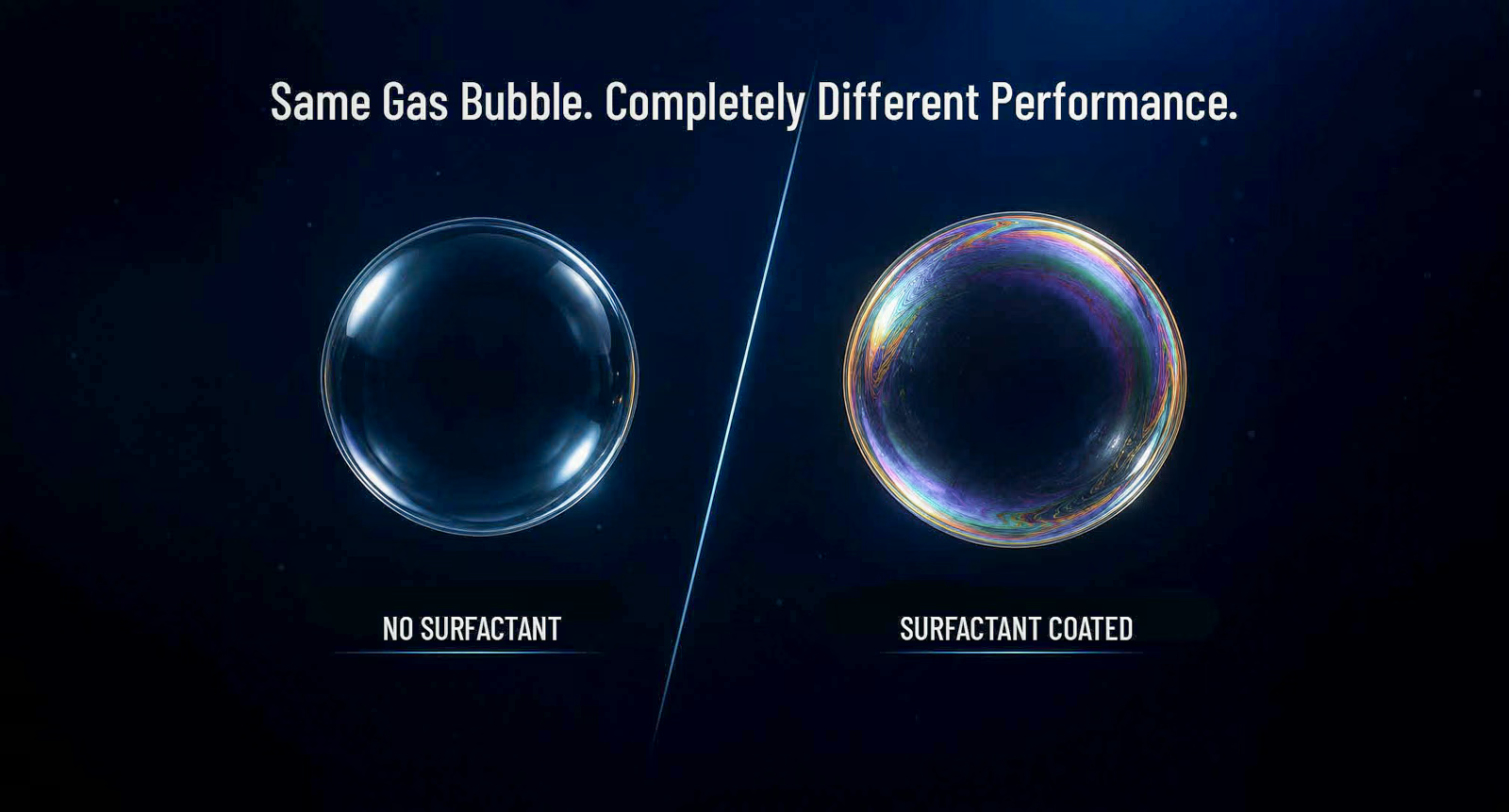
Gas dissolution is the hidden performance variable behind almost every gas-transfer system. Whether the application involves oxygenation, ozone treatment, hydrogen infusion, aquaculture, wastewater, agriculture, mining, industrial process water or environmental remediation, the same physical constraint applies: gas must cross the gas-liquid interface before it can become useful in solution.
That interface is where conventional systems lose performance. Large bubbles rise quickly, escape at the surface and waste a significant portion of the gas before dissolution is complete. G-Cav™ is designed to solve that limitation at the point of generation by creating a dense nanobubble population with vastly greater gas-liquid interfacial area.
The Real Limitation Is Not Gas Supply. It Is Interface.
Most gas-transfer systems are built around the assumption that more gas, more pressure or more contact time will improve performance. Those variables matter, but they are not the first constraint. The dominant constraint is the amount of gas-liquid interface created per unit of gas volume.
Conventional technologies such as paddlewheel aerators, venturi injectors, membrane diffusers and fine-bubble systems usually operate with bubbles in the micrometre to millimetre range. These bubbles have low surface-area-to-volume ratios, which means much of the supplied gas can rise and escape before it dissolves.
For operators, this creates a familiar problem: gas is being paid for, pumped and delivered into the system, but not all of it is being converted into useful dissolved gas.
Why Bubble Size Changes Everything
Bubble geometry is unforgiving. Surface area scales with radius squared, while volume scales with radius cubed. As a result, smaller bubbles produce disproportionately more interface from the same amount of gas.
When bubble diameter is reduced from millimetre scale to nanometre scale, the available interfacial area increases by orders of magnitude. This is why nanobubble generation is so important for gas-transfer applications: it changes the geometry of the process before chemistry even begins.
| Bubble Diameter | Approximate Bubbles per Litre of Gas | Approximate Interface per Litre of Gas |
|---|---|---|
| 1 mm conventional bubble | ~1.9 × 10⁶ | ~6 m² |
| 100 µm microbubble | ~1.9 × 10⁹ | ~60 m² |
| 1 µm sub-micron bubble | ~1.9 × 10¹⁵ | ~6,000 m² |
| 70 nm G-Cav™ nanobubble | ~5.6 × 10¹⁸ | ~85,700 m² |
At a nanobubble diameter of approximately 70 nm, one litre of gas can generate around 85,700 m² of gas-liquid interface. At an industrial injection rate of 20 L/min, that represents approximately 1.7 million m² of gas-transfer potential entering the treatment volume every minute.
How G-Cav™ Removes the Kinetic Barrier
G-Cav™ uses vortex-induced multistage hydrodynamic cavitation to fragment injected gas inside the process stream. The liquid and gas pass through successive high-to-low pressure transitions inside the reactor, where repeated implosion events reduce the entrained gas into a dense nanobubble population.
This is not a membrane system and it is not a diffuser system. G-Cav™ does not rely on porous media, which means it avoids the fouling, scaling and clogging liabilities that can limit conventional gas-transfer hardware in high-solids, saline or aggressive water conditions.
The result is a gas-transfer mechanism suited to industrial environments where conventional aeration hardware often loses efficiency over time.
Validated Oxygen Transfer Performance
In controlled laboratory validation, G-Cav™ demonstrated oxygen transfer efficiency above 99% in a 1,000 L closed-loop test at both cool and warm water conditions.
| Metric | 21 °C Test | 31 °C Test |
|---|---|---|
| Starting DO | 4.0 mg/L | 2.87 mg/L |
| Ending DO | 30.0 mg/L | 21.0 mg/L |
| DO Gain | +26.0 mg/L | +18.1 mg/L |
| Transfer Efficiency | >99% | 99.4% |
The practical value of this is simple: gas supplied to the system is converted into dissolved gas with minimal atmospheric loss. Instead of over-supplying gas to compensate for escape, operators can dose closer to the required process target.
Why Predictable Gas Dosing Matters
Gas-transfer systems are often difficult to control because supply and delivery are decoupled. Conventional systems may inject a known volume of gas, but buoyancy, off-gassing, contact time, bubble size, water temperature and water chemistry all influence how much of that gas actually dissolves.
G-Cav™ is designed to narrow that gap. In the validated oxygen test conditions, the relationship was close to a practical mass-flow rule: one gram of oxygen injected produced approximately a 1 mg/L dissolved oxygen increase per 1,000 L of treated water.
That matters because it supports more precise set-point control. Operators can calculate the required gas mass from the treatment volume and target concentration, then dose accordingly while avoiding unnecessary waste and reducing the risk of overshooting the desired operating range.
One Reactor. Multiple Gas Applications.
The same generation mechanism can be used with different feed gases, including oxygen, ozone, hydrogen, air and other process gases. The reactor does not need to become a different machine each time the gas changes. The gas source changes; the hydrodynamic cavitation mechanism remains the same.
This gives G-Cav™ broad relevance across applications that depend on dissolved gas performance, including:
- Aquaculture oxygenation and water quality support
- Municipal and industrial wastewater treatment
- Ozone-assisted oxidation and disinfection processes
- Agricultural water oxygenation and root-zone support
- Mining, flotation and process-water treatment
- Environmental remediation and natural waterbody treatment
- Hydrogen-rich water and specialist gas-infusion applications
Real Water Chemistry Still Matters
G-Cav™ solves the interfacial-area problem at generation. It does not override the physics and chemistry of the receiving fluid after the gas has entered the water.
Once nanobubbles are in the process liquid, their behaviour depends on local saturation, temperature, pressure, ionic strength, contaminants and surface-active species. In clean water, very small bubbles can dissolve rapidly. In real process water, surfactants and other compounds can interact with the bubble interface, slowing dissolution or changing persistence.
This distinction is important. The generation technology determines how effectively gas is presented to the liquid. The liquid environment determines what happens next.
The Commercial Implication
For high-volume water systems, gas-transfer inefficiency is not a minor technical loss. It is a direct operating cost. Gas that escapes at the surface has already consumed equipment capacity, pumping energy and supply cost without performing useful work in the liquid.
By generating a nanobubble population with extremely high interfacial area, G-Cav™ allows more of the supplied gas to enter solution before escape can occur. This can improve process control, reduce wasted gas and increase the intensity of treatment processes that depend on dissolved gas availability.
The larger point is clear: in gas-transfer systems, performance is not only about how much gas is supplied. Performance is about how much gas is successfully delivered into solution.
Conclusion: G-Cav™ Changes the Gas-Transfer Equation
The limiting factor in conventional gas-transfer systems is not usually gas availability. It is the rate at which gas can be presented at an interface small enough for dissolution to occur before buoyancy and surface escape take over.
G-Cav™ addresses that limitation directly. By using vortex-induced multistage hydrodynamic cavitation to generate a dense nanobubble population, the system dramatically increases gas-liquid interfacial area and supports highly efficient gas dissolution across multiple industries.
For operators working with oxygen, ozone, hydrogen, air or other gases, the message is straightforward: if the process depends on dissolved gas, then interface is performance.
Talk to Global Cavitation About Gas-Transfer Performance
G-Cav™ is engineered for industrial gas infusion, oxygen transfer and nanobubble generation across aquaculture, wastewater, agriculture, mining, environmental remediation and process-water applications.
Contact Global Cavitation to discuss pilot evaluation, system sizing or application-specific integration.
Performance data referenced in this article is based on controlled laboratory validation. Site-specific outcomes depend on water chemistry, operating conditions and system configuration. Pilot evaluation is recommended before full-scale deployment.