

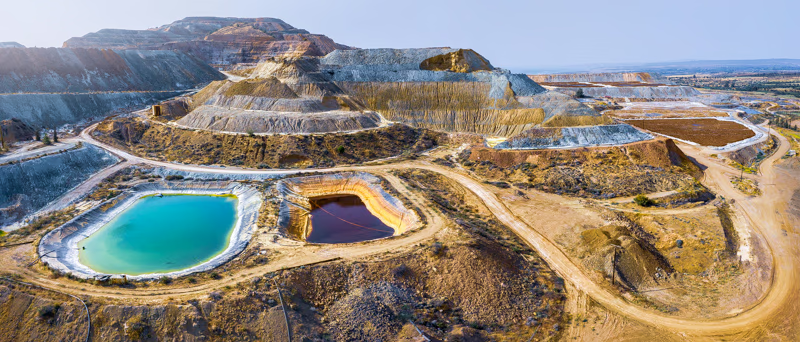
| G-Cav™ – MINING Heap Leach & Hydrometallurgical Oxygen Delivery Accelerating Metal Recovery Through Precision Oxygen Transfer Copper · Gold · Uranium · Nickel · Zinc Global Cavitation Group Holdings Pty Ltd | globalcavitation.com |
|---|
1. Executive Summary
Oxygen is not merely beneficial to hydrometallurgical leaching processes — in most cases it is stoichiometrically essential. The bacteria that oxidise metal sulfides, the chemical oxidants that dissolve noble metals, and the ferric iron regeneration cycle that drives heap leach kinetics all depend on dissolved oxygen availability as a primary rate-controlling variable. Yet conventional oxygen delivery to heap leach piles, bio-leach reactors, and cyanidation circuits consistently falls short: atmospheric diffusion is slow, conventional sparging wastes gas to off-gassing, and in large heap geometries the deep and lower-permeability zones are chronically oxygen-starved regardless of surface aeration rates.
G-Cav™ vortex-induced multistage hydrodynamic cavitation delivers oxygen into the leach solution at greater than 99% gas transfer efficiency — meaning virtually every gram of oxygen supplied is dissolved into solution, wasted to none. This is not a marginal improvement on conventional sparging; it is a fundamental change in the oxygen economy of the leaching process. The system is gas-agnostic, temperature-independent, and operates from existing pump infrastructure, potentially without modification.
This capability statement presents the oxygen delivery mechanism, the specific biochemistry and chemistry of each leaching process that benefits from it, the validated performance data, and the quantified value of improved oxygen availability expressed as metal recovery rate and operating cost reduction.
| >99% Oxygen Transfer Efficiency — temperature independent | 1:1 Mass-in to DO-gain ratio — fully predictable dosing | Zero Chemical addition required | Any Depth, flow rate, or heap geometry — inline or submersible |
|---|
2. The Role of Oxygen in Hydrometallurgical Processes
Hydrometallurgical metal recovery — the use of aqueous solutions to dissolve and recover metals from ores — encompasses a family of processes that share a common dependence on dissolved oxygen. In each case, oxygen serves as the terminal electron acceptor in oxidation reactions that are either directly responsible for metal dissolution or responsible for regenerating the oxidants that perform that dissolution. Understanding the specific role of oxygen in each process is the foundation for understanding the value of improving its delivery.
The central figure in most sulfide leaching processes is the Fe³⁺/Fe²⁺ redox couple. Ferric iron (Fe³⁺) is the primary chemical oxidant that attacks metal sulfide minerals, oxidising the sulfide to sulfate and releasing the target metal into solution. As it does so, Fe³⁺ is reduced to ferrous iron (Fe²⁺). Dissolved oxygen then re-oxidises Fe²⁺ back to Fe³⁺ — either directly through chemical oxidation, or at much faster rates through the enzymatic activity of iron-oxidising bacteria. The rate of the overall leaching process is therefore ultimately governed by the rate at which dissolved oxygen can sustain the Fe³⁺ regeneration cycle. More dissolved oxygen means faster Fe³⁺ regeneration means faster metal dissolution.
| In heap leach operations, dissolved oxygen in the leach solution is consistently identified in the literature as one of the two primary rate-limiting variables — the other being temperature. Every percentage point of improvement in dissolved oxygen concentration in the leach solution translates directly into faster leach kinetics and higher metal recovery within the same leach cycle time. |
|---|
The G-Cav™ Solution: Precision Saturation Delivery
G-Cav™ technology generates true nanobubbles — gas-filled cavities typically between 50 and 250 nanometres in diameter — through a patented hydrodynamic cavitation process. This scale difference from conventional bubble aeration is not merely quantitative but fundamentally alters the gas-water exchange dynamics. To enable clarity and understanding throughout the rest of this document, it is important to introduce the tool and technology that enables the results we share herewith and to assist in the understanding that this technology is absolutely the right technology for mining application of this type.
Introducing G-Cav™ — A Vortex-Induced Multistage Hydrodynamic Cavitation Reactor
Hydrodynamic cavitation is widely recognised for its powerful capabilities and is rapidly emerging as one of the most effective technologies for enhancing water treatment and industrial gas infusion. While single-stage hydrodynamic cavitation is gaining global acceptance, the next generation of this technology has already been developed, delivering a significant step change in performance.
A vortex-induced multistage hydrodynamic cavitation reactor is engineered to both intensify the implosive forces generated by cavitation and multiply their impact through a series of successive implosion chambers within a single pass. These repeated implosion events break apart and homogenise materials present in the fluid — whether organic matter, gas bubbles, or complex liquid mixtures — enabling ultra-fine blending and transformation. In mining applications, this process generates the nanobubble populations that deliver oxygen into solution with exceptional efficiency.
Mechanism of Action
The implosions occur within the core of a vortexing liquid stream, effectively isolating the device itself from the primary destruction/fragmentation zone. At the same time, the vortex drives fluid through successive implosion chambers along the reactor’s length.
The vortex induces an outward centrifugal force, creating a low-pressure zone at its centre, before the fluid is forced back inward, generating intense shear forces and compression. Immediately following this high-compression phase, the fluid enters a rapid decompression and expansion zone, where pressure transitions from highly positive to significantly negative through the centreline of the vortexing fluid as it throws outward again following compression.
This shift alters boiling points and vapourisation behaviour through that centreline, promoting instantaneous expansion followed by a violent collapse, producing powerful implosive forces that act on the adjacent material — in the case of a mining oxygenation process, fragmenting the injected oxygen gas into the nanoscale bubble populations that achieve near-perfect gas transfer efficiency.
Cumulative Effect and Nanoscale Outcomes
The cumulative effect of successive implosion chambers and repeated implosions is the progressive breakdown of larger entrained gas bubbles into micro- and nanoscale structures, including nanoparticles and nanobubbles. This dramatically increases reactive surface area, enhances gas dissolution efficiency, and improves overall reaction potential — regardless of the chemical makeup of the liquid being treated.
Less dense materials will fragment more readily, such as gas, while denser materials may require multiple passes depending on the desired outcome. Ultimately, the process delivers exponentially enhanced results, as each successive implosion chamber builds upon and refines the effects generated in the preceding stage.
Key Processing Principles
The following principles govern G-Cav™ performance across all applications, including the various mining applications of dissolved oxygen management:
Gas is inherently low in density and readily fragments under cavitation conditions — oxygen is therefore ideal for nanobubble generation.
The behaviour of the liquid environment, and the resulting outcomes, are determined by its composition — water quality parameters in the production system directly influence treatment results.
As particle or bubble size decreases, available reactive surface area increases significantly, enhancing gas transfer and the DO saturation potential.
The overall effect is improved gas transfer efficiency, increased processing rates, and enhanced results in less time — enabling efficient gas infusion while reducing infrastructure requirements and lowering energy consumption for equivalent performance.
Competitive Differentiation
Unlike conventional aeration or diffuser-based systems, G-Cav™ technology achieves its outcomes through the creation and controlled harnessing of successive implosions along its length, while continuously blending and mixing the fluid. This process is accomplished without the use of membranes, diffusers, or clog-prone components, ensuring reliable and consistent performance — even in difficult environments such as high chloride, highly acidic or alkaline mediums.
This is a membrane-free system — not an ultrasonic device, not a porous diffuser medium — driven by the controlled action of hydrodynamic implosion. When comparing G-Cav™ with membrane-based or diffuser-based nanobubble generators, the distinction in mechanism is fundamental, and the resulting performance differences in gas dissolution efficiency are both significant and readily observable. Much of the decision making process needs to focus around reliability and material type used to produce a nanobubble generating technology in these types of applications. The G-Cav device can be made from many material types as the liquid environment dictates, from Stainless Steel 316L to different grades of Titanium, Duplex combinations or even engineered synthetic materials. If it can be cast, machined or even printed, the G-Cav geometry will allow for it.
Why Nanobubbles Transfer Differently
The performance advantage of nanobubbles over conventional bubble aeration reduces to a single physical principle: surface area available for gas exchange per unit of gas volume. Gas dissolves into water at the gas-water interface, and dissolution rate is directly proportional to the area of that interface. A nanobubble — practically and typically 50 to 250 nanometres in diameter — has approximately one million times the surface area per unit of gas volume compared to a 1 mm macrobubble. The consequence is that dissolution kinetics at nanoscale are so rapid that the gas transfers into solution before any bubble migration is physically significant.
This is also why atmospheric equilibration — the natural process by which water reacquires dissolved oxygen from the air — is inherently slow: it is constrained by the single flat air-water interface at the pond or tank surface. Conventional diffusers and venturis improve on this by creating internal bubbles, but at macroscale a significant fraction of gas still escapes before dissolving. G-Cav™ nanobubbles remove the escape pathway entirely — not because they are ‘stable’ or ‘persistent’, but because dissolution is essentially instantaneous at that scale. This is the physical basis for >99% OTE.
This all positions G-Cav™ as a critical capital consideration for new or existing aeration/oxygenation processes, a plant critical financial driver with clearly calculable ROI based on the production value of closing the DO deficit.
3. Copper Heap Leaching
3.1 The Biochemistry of Copper Sulfide Leaching
Copper sulfide minerals — principally chalcopyrite (CuFeS₂), chalcocite (Cu₂S), and covellite (CuS) — are dissolved through the combined action of ferric iron oxidation and, in biohydrometallurgical systems, the enzymatic activity of acidophilic iron- and sulfur-oxidising bacteria. The key species include Acidithiobacillus ferrooxidans, Acidithiobacillus thiooxidans, Leptospirillum ferrooxidans, and the thermophilic Sulfolobus species that dominate at higher operating temperatures.
The overall leaching reactions for the primary copper sulfides are:
The third equation is the critical link: bacterial oxidation of Fe²⁺ back to Fe³⁺ consumes dissolved oxygen directly. A. ferrooxidans performs this reaction 500,000 times faster than the uncatalysed chemical reaction — but the enzymatic reaction is still limited by dissolved oxygen availability. At DO levels below approximately 2 mg/L, bacterial activity is measurably suppressed. At levels approaching zero — which occur in the deep interior of large heap leach piles far from the spray emitters — leaching kinetics approach zero regardless of bacterial population density.
| G-CAV™ APPLICATION — COPPER HEAP LEACH G-Cav™ generated oxygen injection into the leach solution supply line — either at the pump feeding the emitters, or via a dedicated injection loop recirculating through the heap — delivers leach solution to the heap surface with dissolved oxygen concentrations substantially above what atmospheric equilibration could possibly ever achieve. The >99% OTE means the full mass of oxygen injected is in solution at the point of application. As solution percolates through the heap, oxygen is available throughout the leach column depth rather than depleting rapidly in the upper layers. |
|---|
3.2 The Conventional Oxygen Delivery Problem
Standard heap leach operations rely on atmospheric oxygen diffusing into the leach solution in the spray pond or distribution header, supplemented in some operations by low-pressure air injection through the heap floor. Both approaches have fundamental limitations.
Atmospheric equilibration of the leach solution is constrained by Henry’s Law — the equilibrium DO concentration at 25°C and atmospheric partial pressure of oxygen is approximately 8 mg/L in clean water, and lower in the high-ionic-strength, low-pH leach solution typical of copper SX-EW circuits. The approach to equilibrium from atmospheric contact is slow, requiring extended retention time in the spray pond. More critically, as temperature rises in tropical and high-temperature operations — where many of the world’s largest copper heap leaches operate — equilibrium DO falls further, constraining bacterial activity precisely where the thermal conditions would otherwise favour the thermophilic bacterial species capable of higher leach rates.
Floor aeration systems inject air through perforated pipes at the base of the heap. This improves oxygen availability in the lower heap layers but the air must travel upward through the entire heap profile, is subject to channelling through high-permeability zones, and provides relatively modest dissolved oxygen enhancement in the leach solution itself. The gas phase in the heap is not the same as dissolved oxygen in the leach solution contacting mineral surfaces.
3.3 The G-Cav™ Oxygen Delivery Advantage
G-Cav™ oxygen nanobubble injection into the leach solution supply addresses the delivery problem at its source — the leach solution itself — rather than attempting to supply oxygen through the heap gas phase or relying on surface equilibration. Three specific advantages compound:
Transfer efficiency: Greater than 99% of the oxygen mass injected is dissolved into the leach solution in the single pass through the G-Cav™ unit. Conventional venturi or diffuser injection into the leach circuit loses 40–80% to off-gassing. For a heap leach operation spending $500,000 annually on oxygen supply, this efficiency difference represents $200,000–$400,000 in avoidable waste.
Temperature independence: G-Cav™ OTE does not decline with increasing water temperature — validated at both 21°C and 31°C with no reduction in transfer efficiency. The mass of oxygen dissolved per unit of gas injected is governed by the mass-flow relationship alone, not by temperature-dependent solubility kinetics. This means G-Cav™ maintains full performance in hot tropical operations where conventional aeration is most compromised.
Predictable dosing: The 1:1 mass-flow relationship means operators can calculate precisely: if you inject 20 grams of oxygen per cubic metre of leach solution, dissolved oxygen increases by 20 mg/L. This enables closed-loop DO control — target DO concentration at the emitter is set, injection rate is calculated from flow volume, and the system maintains that setpoint regardless of ambient conditions.
3.4 Quantifying the Value: Copper Recovery Economics
The economic value of improved leach kinetics is expressed in two ways: higher copper recovery within the same leach cycle, or the same copper recovery in a shorter leach cycle. Both translate to direct revenue.
| Parameter | Conventional Aeration | G-Cav™ Oxygen Injection |
|---|---|---|
| DO in leach solution at emitter | 2–5 mg/L (temperature dependent) | >15 mg/L (temperature independent) |
| DO in deep heap profile | Near zero — oxygen-starved zones | Maintained throughout — solution-borne |
| Bacterial Fe²⁺ oxidation rate | Limited by DO availability | Sustained at near-optimal DO |
| Oxygen waste to off-gassing | 40–80% of injected gas lost | <1% — >99% OTE |
| DO control precision | Weather and temperature dependent | Mass-flow predictable — set-point operable |
| Performance in hot climates | Degraded — lower equilibrium DO | Unaffected — efficiency independent of temperature |
Published heap leach literature consistently documents 10–25% improvement in copper recovery rates in well-oxygenated versus oxygen-limited heap leach systems operating on comparable ore. For a 50,000-tonne-per-year copper operation at $9,000/tonne LME copper, a 10% improvement in recovery yields $45M additional annual revenue — against a G-Cav™ capital and operating cost that is a small fraction of that figure.
4. Gold Heap Leach and Carbon-in-Leach Cyanidation
Gold cyanidation is governed by the Elsner equation, one of the most important reactions in hydrometallurgy:
Oxygen is stoichiometrically required — four moles of gold dissolution consume one mole of oxygen. There is no alternative oxidant in the standard cyanidation circuit. Dissolved oxygen concentration in the cyanide leach solution is therefore a direct rate-determining variable for gold dissolution, and insufficient DO is one of the most common causes of suboptimal gold recovery in both heap leach and agitated carbon-in-leach (CIL) circuits.
4.1 Why Oxygen Limits Gold Recovery
Gold heap leach operations typically apply cyanide solution at 50–200 ppm NaCN concentration. In the heap interior, the reaction rate is jointly determined by cyanide concentration and dissolved oxygen concentration. At the DO levels achievable through conventional surface equilibration — particularly in warm climates — oxygen is frequently the limiting reagent rather than cyanide. Operators who increase cyanide addition without addressing the oxygen deficit see diminishing returns: there is excess cyanide available but insufficient oxygen to drive the dissolution reaction at full rate.
In agitated CIL tanks, mechanical agitation improves oxygen transfer from the atmosphere, but at high pulp densities (35–45% solids) the oxygen demand from both gold dissolution and from oxidisable sulfide minerals in the ore can exceed the atmospheric transfer rate. Supplemental oxygen injection is standard practice in many CIL circuits — but the efficiency of that injection, typically through spargers or venturis, is poor, wasting 40–60% of the oxygen supply.
| G-CAV™ APPLICATION — GOLD CYANIDATION G-Cav™ oxygen nanobubble injection into the cyanide leach solution supply — for heap leach, at the pump feeding the emitter system; for CIL, inline on the inter-tank transfer lines — ensures that gold-bearing solution contacts mineral surfaces with the highest achievable dissolved oxygen concentration. The >99% OTE means the full value of the oxygen supply budget is delivered into the leach solution rather than lost to the atmosphere. In CIL applications, the nanobubble population persists through the agitated slurry, providing sustained oxygen availability throughout the tank volume rather than depleting immediately at the sparger. |
|---|
4.2 The Preg-Robbing and Oxygen Demand Consideration
In ores containing carbonaceous material — refractory or ‘preg-robbing’ ores — elevated dissolved oxygen can sometimes promote the adsorption of gold cyanide complexes onto carbonaceous matter before recovery on activated carbon. Operators treating preg-robbing ores should assess the specific ore mineralogy before maximising DO injection rates. For the majority of non-refractory gold ores, higher DO is unambiguously beneficial. G-Cav™’s mass-flow dosing precision allows DO to be set at any target level — including conservative levels appropriate for borderline preg-robbing ores — rather than the uncontrolled atmospheric DO of conventional systems.
5. Uranium Acid Heap Leaching
Uranium oxide minerals — principally uraninite (UO₂) — are dissolved in acidic leach solutions through oxidation to the soluble hexavalent form UO₂²⁺ (the uranyl cation). The primary oxidant, again, is ferric iron — and the Fe²⁺ regeneration cycle by iron-oxidising bacteria requires dissolved oxygen by exactly the same mechanism as in copper sulfide leaching:
The G-Cav™ oxygen delivery advantage applies identically to uranium acid heap leaching as to copper sulfide leaching: the mechanism is the same, the rate-limiting step is the same, and the solution is the same. Uranium heap leach operations in Australia, Kazakhstan, Namibia, and Canada that struggle with low leach kinetics in deep heap profiles or warm-climate reduced DO conditions are direct candidates for G-Cav™ oxygen injection.
One additional consideration for uranium operations: the leach solution chemistry is typically more complex than copper circuits, with higher ionic strength and more diverse mineral dissolution consuming oxygen demand from non-target reactions. G-Cav™’s ability to precisely dose dissolved oxygen to a set-point allows operators to supply only the oxygen needed for the target reaction, rather than over-supplying to compensate for poor transfer efficiency.
6. Nickel and Zinc Sulfide Bioleaching
Nickel and zinc sulfide minerals — pentlandite (Ni,Fe)₉S₈ and sphalerite (ZnS) — undergo bioleaching by the same iron- and sulfur-oxidising bacterial community that drives copper sulfide dissolution. The reaction pathway is mechanistically identical:
Nickel and zinc bioleaching is more commonly applied to concentrates in stirred-tank reactors (BIOX®, BacTech, Minbac systems) than to run-of-mine heap leach configurations. In stirred-tank bioleach reactors, dissolved oxygen is supplied by sparging and mechanical agitation — and oxygen limitation is a recognised challenge at high pulp densities and high bacterial metabolic rates. G-Cav™ inline injection on the reactor feed or recirculation loop provides substantially higher dissolved oxygen at the point of entry, sustaining bacterial activity at higher rates throughout the reactor residence time.
The economic case is particularly compelling for nickel bioleaching given nickel’s current strategic importance in battery cathode materials and the premium attached to efficiently processed, lower-carbon nickel. Any improvement in bioleach kinetics that reduces energy per tonne of nickel recovered or shortens the process time also reduces the carbon intensity of the operation — a commercially significant attribute in battery supply chains under ESG scrutiny.
7. G-Cav™ Oxygen Delivery: System Description
G-Cav™ oxygen nanobubble injection for hydrometallurgical applications uses the same core reactor technology as the company’s water treatment platform. The vortex-induced multistage hydrodynamic cavitation process fragments injected oxygen into micro- and nanoscale bubble populations with enormous total gas-water surface area, driving essentially instantaneous gas dissolution into the leach solution before any bubble migration occurs. The reactor contains no membranes, no diffusers, and no clog-prone components — critical for operation in the abrasive, acidic, and high-solids environments typical of heap leach circuits.
7.1 Validated Oxygen Transfer Performance
The G-Cav™ oxygen transfer performance has been validated in controlled laboratory testing at two temperatures relevant to heap leach operations. In a single pass of a 1,000-litre test volume, the system achieved:
| Temperature | Starting DO | DO Gain (single pass) | Transfer Efficiency |
|---|---|---|---|
| 21°C (Cool) | 4.0 mg/L | +26.0 mg/L | >99% |
| 31°C (Warm) | 2.87 mg/L | +18.1 mg/L | 99.4% |
The gas-to-water flow ratio for these results was approximately 2.0% at 21°C and 1.5% at 31°C — the difference reflecting reduced oxygen gas density at higher temperature, not any reduction in transfer efficiency. Both ratios are well within the operating range of standard pump systems serving heap leach emitter networks.
| The mass-flow principle is the foundation of G-Cav™ oxygen dosing for leaching: inject 20 grams of oxygen per cubic metre of leach solution and dissolved oxygen increases by 20 mg/L — regardless of water temperature, regardless of circuit pressure, regardless of the season. This predictability enables set-point DO control that conventional aeration systems cannot achieve. |
|---|
7.2 Deployment Configurations for Heap Leach
| Configuration | Application | Description |
|---|---|---|
| Inline on leach solution supply | All heap leach types | G-Cav™ unit inline on the pump main feeding the emitter distribution header. Entire leach solution volume treated at the pump. Single installation point serves the full heap footprint. |
| Inline on raffinate return | SX-EW copper circuits | G-Cav™ unit on the raffinate return line from the SX circuit. Raffinate is typically depleted in DO after solvent extraction — re-oxygenating before return to heap maximises DO at re-application. |
| Recirculation loop on leach ponds | Heap leach with holding ponds | G-Cav™ unit on a recirculation loop drawing from and returning to the leach solution holding pond. Multiple passes progressively raise DO to target level before solution is pumped to emitters. |
| Inline on CIL inter-tank transfer | Carbon-in-leach gold circuits | G-Cav™ units on transfer lines between CIL tanks. Each tank receives freshly oxygenated slurry, maintaining DO throughout the CIL train rather than relying solely on mechanical agitation. |
| Inline on bioreactor feed | Stirred-tank bioleach (Ni, Zn) | G-Cav™ unit on the feed line to stirred-tank bioleach reactors. Sustained high-DO feed maintains bacterial activity at high pulp densities where sparging alone is insufficient. |
8. Return on Investment Framework
The economic case for G-Cav™ oxygen injection in hydrometallurgical operations is driven by three independent value streams, each of which is positive in isolation. Combined, they typically deliver capital payback well within a year or so depending on operation scale and current oxygen delivery efficiency.
| Value Stream | Mechanism | Order of Magnitude |
|---|---|---|
| Increased metal recovery | Higher DO sustains bacterial Fe²⁺ oxidation at near-optimal rate throughout heap depth and leach cycle; more metal dissolved per tonne of ore | 5–25% improvement in recovery rate — direct revenue at prevailing metal price |
| Reduced oxygen supply cost | >99% OTE versus 20–60% for conventional sparging/venturi — same dissolved oxygen delivered at fraction of the gas volume | 40–80% reduction in oxygen consumption per unit of DO delivered |
| Shorter leach cycle | Faster kinetics from sustained DO allow equivalent recovery in reduced time — heap turns over faster, capital is redeployed sooner | 10–20% reduction in leach cycle time — equivalent improvement in asset utilisation |
| Reduced acid consumption | Faster and more complete sulfide oxidation reduces residual sulfide acid demand in later leach stages | Operation-specific — typically 5–15% reduction in acid consumption |
For a reference operation producing 50,000 tonnes per annum of copper cathode at $9,000/tonne, a 10% improvement in heap leach recovery generates $45M additional annual revenue. G-Cav™ capital cost for the inline injection system on a heap leach of this scale is typically in the range of $500,000–$2,000,000 depending on the number of installation points and the pump infrastructure already in place. Payback at the moderate recovery improvement scenario is measured in weeks to months, not years.
9. About Global Cavitation Group Holdings
Global Cavitation Group Holdings Pty Ltd is an Australian technology company headquartered in Cairns, Queensland. The G-Cav™ vortex-induced multistage hydrodynamic cavitation platform is a patented nanobubble generation system with field-validated gas transfer performance across produced water treatment (Permian Basin), biogas enhancement (190% methane production increase), and water treatment applications globally.
The company has active engagement with mining operators across the Permian Basin, Kazakhstan, and Australia, and welcomes discussions with heap leach and bioleach operators seeking to evaluate G-Cav™ oxygen delivery performance against their specific circuit parameters and ore characteristics.
| Contact | Details |
|---|---|
| Website | globalcavitation.com |
| info@globalcavitation.com | |
| Phone | +61 7 4028 3830 |
| Address | 26 Donaldson Street, Manunda QLD 4870, Australia |
Technical Note
Oxygen transfer performance figures cited in this document are derived from controlled laboratory testing of the G-Cav™ system. Specific improvements in metal recovery rates for individual heap leach or bioleach operations depend on ore mineralogy, bacterial population characteristics, heap geometry, current oxygen delivery efficiency, temperature, and acid balance. The values stated represent published literature ranges for well-oxygenated versus oxygen-limited systems and are not G-Cav™-specific performance guarantees. Global Cavitation recommends a circuit assessment and pilot evaluation before full-scale deployment.
Talk to Global Cavitation about your application
The performance of any gas-transfer, flotation or water-treatment system depends on site-specific chemistry, flow conditions and process objectives. Global Cavitation can help evaluate whether G-Cav™ technology is suitable for your application and identify the most practical integration pathway.
For technical information, pilot testing discussions, licensing opportunities or project-specific assessments, contact the Global Cavitation team.
Phone: +61 7 4028 3830
Email: info@globalcavitation.com
Address: 26 Donaldson St, Manunda, Cairns, QLD 4870, Australia
Contact: Speak with Global Cavitation
Talk to Global Cavitation about your application
The performance of any gas-transfer, flotation or water-treatment system depends on site-specific chemistry, flow conditions and process objectives. Global Cavitation can help evaluate whether G-Cav™ technology is suitable for your application and identify the most practical integration pathway.
For technical information, pilot testing discussions, licensing opportunities or project-specific assessments, contact the Global Cavitation team.
Phone: +61 7 4028 3830
Email: info@globalcavitation.com
Address: 26 Donaldson St, Manunda, Cairns, QLD 4870, Australia
Contact: Speak with Global Cavitation