

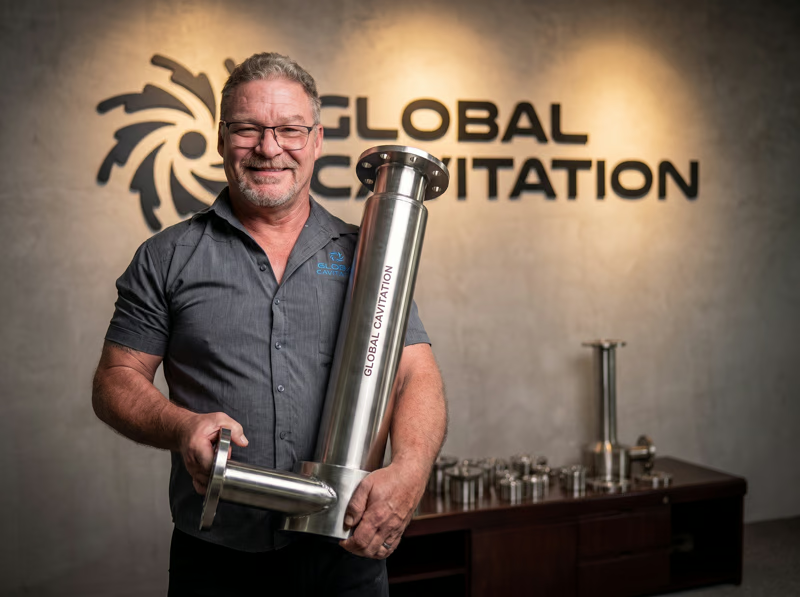
What Happens Inside a G-Cav™ Reactor: How Multistage Hydrodynamic Cavitation Turns Flow Into Process Performance
Hydrodynamic cavitation is one of the most important physical mechanisms behind the G-Cav™ platform.
At its simplest, hydrodynamic cavitation occurs when rapid pressure changes inside a moving liquid create transient vapour cavities. These cavities expand and then collapse, releasing intense localised energy inside the fluid itself.
That localised energy is what makes cavitation commercially useful.
Instead of relying only on external mechanical mixing, porous diffusers or passive gas injection, hydrodynamic cavitation uses the behaviour of the moving liquid to create stronger internal process conditions. Those conditions can intensify mixing, fragment gas and solids, disturb suspended matter, destabilise emulsions and improve contact between gas, liquid and solids.
For industrial water treatment, that distinction matters.
The question is not only whether gas can be introduced into a liquid. The more important question is whether the system creates a commercially useful interaction between the gas, the liquid, the contaminants and the process conditions.
G-Cav™ is designed around that broader objective.
Not All Cavitation Systems Are Equal
G-Cav™ is not a simple one-stage venturi. It is not a generic inline mixer that produces cavitation as a side effect.
The platform is designed as a vortex-induced multistage hydrodynamic cavitation reactor. That means the liquid is not exposed to only one cavitation event before leaving the active zone. Instead, the fluid moves through a sequence of chambers where cavitation conditions are repeated and intensified.
Each stage builds on the work of the previous stage.
Gas, suspended matter and mixed-phase material are progressively fragmented and refined as they move through the reactor. This cumulative action is central to the G-Cav™ platform. It is what separates a multistage cavitation reactor from basic gas injection or simple flow-restriction devices.
The G-Cav™ Process Sequence
The G-Cav™ mechanism can be understood as a sequence of physical events.
First, the process liquid enters the reactor under pump pressure. The reactor geometry accelerates the fluid and creates conditions for high-intensity vortex formation.
Second, the vortex creates a pressure structure inside the moving liquid. The outer flow region experiences higher pressure, while the centre of the vortex develops a lower-pressure region. This produces strong radial and axial flow behaviour.
Third, as the liquid moves through the chamber geometry, it experiences rapid shifts between high-compression and decompression conditions. These pressure changes allow transient cavities to form within the liquid stream.
Fourth, when conditions change again, the cavities collapse. These implosive collapse events generate localised energy that acts on the surrounding fluid, gas and entrained material.
Fifth, in G-Cav™, the process repeats. The liquid continues through successive cavitation chambers, exposing it to repeated cavitation events in a single reactor path.
This multistage repetition is the core of the platform.
It is also important to understand where the most aggressive cavitation activity occurs. In G-Cav™, the destructive cavitation forces are concentrated within the vortex structure itself, rather than being directed into the reactor body. This is a key part of the G-Cav™ method and one of the reasons the platform is designed for robust industrial deployment. We will explore this in more detail in a future post.
Why Cavitation Matters for Gas Infusion
The value of G-Cav™ becomes especially clear when gas is introduced into the liquid stream.
Conventional gas-transfer systems often rely on coarse bubbles, diffusers or membrane-based delivery. These systems can be limited by off-gassing, fouling, inconsistent contact and reduced performance in contaminant-rich environments.
G-Cav™ approaches the problem differently.
Gas is introduced into an active cavitation environment where repeated pressure transitions and implosive events progressively fragment and disperse it. As the gas phase is refined into smaller structures, the available gas-liquid interfacial area increases sharply.
That increased interfacial area creates stronger conditions for gas-liquid interaction. This is relevant to oxygen transfer, oxidation, sanitation, remediation, flotation and biological support applications.
The commercial point is direct: gas is not just being pushed into water. It is being processed into a form that can interact more effectively with the liquid environment.
Why Cavitation Matters for Separation and Flotation
Hydrodynamic cavitation is not only useful for gas infusion.
It also changes the physical condition of mixed-phase liquids. Cavitation-driven shear and implosive collapse can disturb emulsified systems and surfactant-stabilised boundaries. In the right process environment, this can help hydrophobic substances interact with gas surfaces and become easier to separate.
When cavitation is combined with ultra-fine gas structures, the result is a strong platform for flotation, separation enhancement and Gibbs Adsorption.
In industrial wastewater, this can support pre-treatment and contaminant concentration. In oil and gas, it can support produced-water treatment and oil-water separation. In mining, it can contribute to flotation and process optimisation.
The common principle is the same across these applications: G-Cav™ uses one physical mechanism to intensify contact, fragmentation and separation inside a flowing liquid stream.
The Difference From Conventional Systems
Conventional diffuser and membrane systems are often judged by a narrow standard: can they push gas into a liquid?
G-Cav™ should be judged by a broader standard: does it create a more useful interaction between gas, liquid, solids and process conditions?
This distinction is important because industrial liquids are rarely clean or simple. They may contain suspended solids, oils, biological load, surfactants, minerals or other contaminants that reduce the performance of conventional equipment.
Membrane-based systems can introduce maintenance risk, clogging exposure and performance decline in difficult liquids. Coarse aeration can waste gas because the bubbles are too large and unstable to create efficient contact.
G-Cav™ is positioned differently. It uses hydrodynamic energy, multistage cavitation and membrane-free architecture to create an active process environment rather than a passive delivery event.
Why the Mechanism Matters
The technical explanation matters because it supports commercial credibility.
G-Cav™ is not a collection of disconnected claims across different industries. It is one underlying mechanism that can be translated into multiple industrial outcomes.
The same multistage cavitation logic can support gas infusion, flotation, oxygenation, oxidation, process-water improvement and separation enhancement.
That is why understanding how hydrodynamic cavitation works is important for operators, engineering groups, licensing partners and industrial project developers.
The value is not only that the system can be used across sectors. The value is that those sectors are connected by the same physical foundation: repeated cavitation, intensified gas-liquid-solids interaction and process improvement inside a robust industrial flow path.
More Than Nanobubbles
G-Cav™ is a multistage hydrodynamic cavitation reactor engineered to transform fluid treatment through controlled cavitation, gas infusion and high-intensity mixing.
It is not a single-function bubble generator. It creates a multi-factor treatment environment that can support emulsion breaking, particulate breakup, increased surface-area interaction and improved gas-liquid-solid contact in heavily contaminated fluids.
Unlike membrane-based or single-factor technologies, G-Cav™ uses cavitation-driven forces to fractionate, mix and activate multiple treatment effects simultaneously, improving process efficiency across a broad range of applications.
Learn More
To understand the detailed mechanism behind the G-Cav™ platform, visit the full page: How Hydrodynamic Cavitation Works.
To discuss an industrial water, gas infusion, wastewater, mining or oil and gas application, contact Global Cavitation.