

New PFAS Removal Technology – 2026: Gibbs Adsorption Mechanisms for PFAS Concentration and the Strategic Business Opportunity in Global Wastewater Treatment
Executive Summary
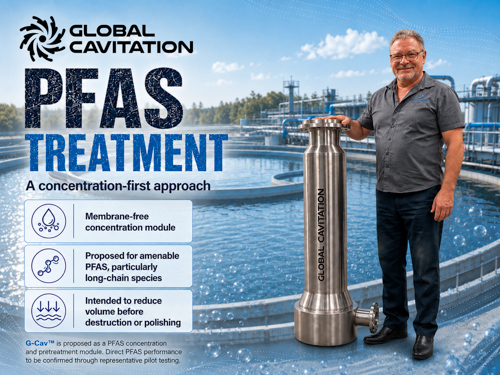
The G-Cav™ platform is a patented multistage hydrodynamic cavitation reactor that generates a dense population of nanobubbles through vortex-induced pressure dynamics. This architecture delivers exceptional gas-liquid interfacial area and simultaneous mechanical emulsion-breaking action. The governing mechanisms — cavitation-driven film disruption and Gibbs adsorption interfacial scavenging — enable efficient concentration of surface-active contaminants into a low-volume, skimmable foam phase.
For per- and polyfluoroalkyl substances (PFAS), particularly long-chain species, the thermodynamic affinity of these compounds for gas-water interfaces makes them highly amenable to this concentration pathway. Published foam fractionation research and operational systems (including ozone-enhanced variants) routinely achieve >90% removal for targeted long-chain PFAS from complex matrices such as landfill leachate and reverse osmosis concentrate. G-Cav represents an intensified, membrane-free implementation of the same principle, with field-validated robustness in high-salinity, emulsified produced water (64.6% TOG removal in a single pass, Permian Basin, 2025).
In the current market, leading contractors such as Veolia (BeyondPFAS end-to-end portfolio) and Ovivo (Olift™ continuous ozone foam fractionation integrated with Obreak™ electrochemical oxidation) are actively commercializing capture-and-destroy solutions. G-Cav offers a high-performance concentration module that can be integrated upstream of destruction or polishing steps. The primary commercial value is volume reduction: by concentrating PFAS into a fraction of the original flow, downstream destruction reactor sizing, energy demand, and residual waste handling costs are materially reduced. This improves project economics and lowers client liability exposure.
to deliver more complete treatment trains, strengthen competitive positioning in large bids, and create pathways for scope expansion. A successful PFAS intervention on a site or catchment can naturally extend to broader environmental remediation, oxygenation, and water quality programs — supporting the “keep the whole job in one place” model that converts individual technology wins into multi-year, multi-hundred-million (or billion-scale phased) infrastructure and services contracts.
This briefing provides senior technical and commercial audiences with a precise engineering description of the mechanisms, their specific linkage to PFAS, alignment with existing leader strategies, cost and opportunity ramifications, and a recommended evaluation pathway.
1. Technology Identification: The G-Cav Platform
G-Cav™ is a vortex-induced multistage hydrodynamic cavitation reactor designed for robust nanobubble generation and advanced gas-liquid processing without membranes, diffusers, or porous media. Fluid passes through a series of engineered low-pressure zones and pressure recovery stages within a single reactor pass. Each stage produces transient cavitation events — vapour cavity formation followed by implosive collapse — that generate:
- High-magnitude pressure shockwaves capable of mechanically disrupting stabilized interfacial films (emulsion breaking).
- Progressive fragmentation of injected gas into a polydisperse bubble population extending into the true nanoscale (~70 nm target diameter).
The practical consequences are twofold and synergistic:
Interfacial Area: At approximately 70 nm mean diameter, one litre of injected gas creates on the order of 85,700 m² of gas-water interface distributed throughout the treatment volume. This is orders of magnitude greater than conventional coarse-bubble or even microbubble systems and provides the physical substrate for thermodynamic scavenging.
Mechanical Energy Delivery: The implosion shockwaves act directly on contaminant-stabilizing films at the molecular scale, a capability absent from passive aeration or simple gas sparging.
Field validation on Permian Basin produced water (26 September 2025, single-pass configuration, nitrogen injection, no chemical addition) demonstrated 64.6% removal of total oil and grease (570 ppm influent to 202 ppm effluent). Visual observation confirmed immediate formation of a coherent, skimmable surface oil layer. This result, obtained in a high-salinity, naturally surfactant-stabilized, emulsified matrix, establishes a conservative performance floor for the combined physical separation mechanisms. The same reactor architecture supports selectable gas injection (air, oxygen, ozone, hydrogen, carbon dioxide) for chemistry-specific applications while retaining the core cavitation and nanobubble generation physics.
The platform is already deployed or under evaluation across produced water, industrial wastewater pretreatment, environmental remediation (open-water and groundwater), aquaculture recirculation, and biogas enhancement verticals. All applications rest on the same underlying multistage cavitation engine.
2. Gibbs Adsorption Mechanism and Sub-Micro Flotation
Two coupled physical processes operate simultaneously within the G-Cav reactor.
Cavitation Emulsion Breaking (Mechanical Component): Surfactant-stabilized emulsions resist conventional gravity or coalescing separation because the adsorbed monolayer prevents droplet contact and coalescence. The high-pressure shockwaves generated by cavitation bubble collapse deliver localized mechanical impulses sufficient to displace or disrupt this monolayer. Once the protective film is compromised, droplets coalesce according to Stokes’ law, rise, and separate. This is the mechanism directly responsible for the observed oil liberation in the Permian Basin validation.
Gibbs Adsorption Interfacial Scavenging (Thermodynamic Component): Surfactant molecules are amphiphilic by definition; they spontaneously accumulate at gas-water interfaces to reduce system free energy. The Gibbs adsorption isotherm quantifies this relationship:
where Γ is the surface excess concentration at the interface, γ is surface tension, c is bulk concentration, R is the gas constant, and T is temperature. In practical terms, any gas-water interface in contact with surfactant-containing water experiences continuous migration of surfactant molecules to the interface until equilibrium is approached.
The nanobubble cloud generated by G-Cav multiplies the available interface by orders of magnitude. Surfactant depletion from the bulk phase raises bulk surface tension toward the clean-water reference value (~72 mN/m at 25 °C). As bulk surfactant concentration falls, the thermodynamic driving force for hydrophobic compounds (oils, fats, proteins, long-chain PFAS) to remain dispersed diminishes; these species are expelled to the only remaining low-energy boundary — the accumulating surface foam.
Self-Reinforcing Interaction: The two mechanisms amplify each other. Cavitation liberates oil droplets from emulsion; simultaneous Gibbs scavenging removes the free surfactant that would otherwise re-stabilize them. Surfactant depletion weakens remaining interfacial films, making subsequent cavitation events more effective. The net result is progressive restoration of bulk water surface tension and concentration of amenable contaminants into a manageable foam phase. Concentration factors of 10–100× are commonly reported in foam fractionation literature for surface-active species; the higher interfacial area and mechanical assist of G-Cav are expected to deliver performance at or above this range in suitable matrices.
A further and highly significant consequence of bulk surfactant depletion is the elimination of a major competitive sink for reactive oxidants. In surfactant-laden matrices, dissolved amphiphiles rapidly scavenge ozone and hydroxyl radicals, severely limiting oxidative efficacy and mass transfer from the gas phase. By progressively stripping these compounds through Gibbs adsorption, the G-Cav process clears reactive pathways, enabling substantially higher mass transfer of ozone (or other selected gases) from the nanobubble interior into the surrounding liquid. When the system is operated with ozone injection and, where appropriate, UV augmentation, this produces efficient in-situ generation of hydroxyl radicals. The outcome is a synergistic advanced oxidation capability operating in parallel with physical concentration: PFAS and other surface-active or hydrophobic micropollutants (including certain hormone-active pharmaceuticals) are collected and concentrated in the foam while residual dissolved species experience enhanced oxidative attack. This dual-mode action materially improves oxidative performance per unit of ozone consumed and prepares both the foam concentrate and the treated effluent for more efficient downstream processing.
The surface foam is not waste in the conventional sense; it is a concentrated stream whose volume is a small fraction of the treated flow, suitable for targeted downstream processing (destruction, recovery, or incineration).
3. Specific Association with PFAS Removal
Long-chain per- and polyfluoroalkyl substances exhibit strong surface activity arising from their amphiphilic molecular architecture: a polar head group and a highly hydrophobic, fluorinated carbon tail that preferentially orients toward the gas phase at interfaces. This property is the basis for their removal by foam fractionation, a technique now supported by multiple peer-reviewed studies and commercial deployments achieving >90% removal for regulated long-chain species (PFOS, PFOA, PFHxS, etc.) from landfill leachate, groundwater, and industrial effluents.
G-Cav applies the identical thermodynamic driver at higher intensity:
- True nanobubble diameters maximize interfacial area per unit gas volume and improve contact efficiency throughout the treatment volume.
- Cavitation shockwaves provide supplementary mechanical energy that can enhance mass transfer and mitigate certain matrix effects.
- The platform architecture is membrane-free and therefore inherently resistant to fouling — a significant operational advantage in high-solids, high-TDS, or organically loaded waters.
- Gas flexibility allows air for pure physical concentration or ozone co-injection where simultaneous oxidation is beneficial.
Role in the Treatment Train: G-Cav is positioned as a concentration and pretreatment module, not a standalone mineralization technology. By reducing the volumetric flow requiring energy-intensive destruction (electrochemical oxidation, plasma, hydrothermal processing, or supercritical water oxidation) or polishing (GAC, ion-exchange), it delivers proportional reductions in:
- Destruction reactor CAPEX and OPEX.
- Volume and handling cost of any PFAS-containing residual waste.
- Overall project risk profile and long-term liability.
Short-chain PFAS are generally less surface-active and may require adjunct measures (e.g., surfactant addition or hybrid polishing) for comprehensive removal; species-specific performance must be quantified in site-representative pilots. The mechanistic case for long-chain PFAS is direct and strong; the Permian Basin result provides a conservative baseline for physical separation performance in complex matrices.
4. Alignment with Leading Global Water Treatment Companies
Veolia — BeyondPFAS Portfolio: Veolia has positioned itself as a comprehensive PFAS solutions provider with capabilities spanning analysis, conventional adsorption (granular activated carbon and ion-exchange resins), advanced treatment, and responsible destruction/disposal of residuals. The company reports successful implementation at more than 30 municipal sites in the United States (including large-scale plants treating up to 30 million gallons per day) and more than 20 industrial projects, with additional programs underway. Delivery models include design-build and design-build-operate. Recent strategic moves, including a major Australian soil remediation acquisition, further strengthen its PFAS remediation footprint.
G-Cav complements this portfolio by supplying a high-efficiency, membrane-free concentration step that can reduce loading on adsorption media and shrink the scale of downstream destruction infrastructure. Integration supports Veolia’s objective of delivering complete, lower-liability end-to-end solutions and enhances competitiveness in large municipal and industrial bids where clients prioritize both performance and residual risk management.
Ovivo — Olift™ + Obreak™ Integrated System: Ovivo has commercialized a “concentrate-and-destroy” approach specifically for PFAS, licensing ozone foam fractionation technology (Olift™) and pairing it with on-site electrochemical oxidation (Obreak™) for mineralization of the collected foamate. Field demonstrations in landfill leachate have shown high removal of targeted PFAS species with significant reduction in waste volume and associated liability. This philosophy — upstream concentration to enable economical, on-site destruction — is precisely the value proposition G-Cav is engineered to deliver at high intensity.
G-Cav’s multistage cavitation and true nanobubble generation offer potential performance or operational differentiation in selected matrices (greater interfacial area, mechanical film disruption, robustness in high-TDS or emulsified streams, multi-gas capability). Natural collaboration pathways exist given overlapping technical heritage (Australian technology origins) and geographic reach. Licensing or integration discussions would allow Ovivo to evaluate an enhanced or alternative concentration engine within its proven treatment architecture.
Other technology providers specializing in electrochemical, plasma, or hybrid destruction similarly benefit from a robust upstream concentration step that improves the economics and practicality of their core modules.
The unifying commercial logic across these organizations is the same: clients facing stringent PFAS regulations (U.S. EPA MCLs, forthcoming industrial effluent guidelines, EU and Australian standards) prefer integrated solutions that demonstrably reduce both immediate compliance risk and long-term liability. A technology that materially improves concentration efficiency and waste minimization strengthens the overall offering and supports capture of larger, higher-value contracts.
5. Financial Ramifications and Business Opportunity Creation
Cost Implications for Project Owners and Integrators
PFAS destruction and mineralization technologies are inherently energy- and capital-intensive because of the strength of carbon-fluorine bonds. Any pretreatment that reduces the volumetric flow or mass load entering the destruction stage produces near-linear savings in reactor sizing, energy consumption, and chemical demand. Concentration factors achievable through interfacial foam fractionation (commonly 10–100× in the literature) translate directly into proportional reductions in destruction infrastructure and operating cost.
Additional cost advantages include:
- Extended service life or reduced replacement frequency of downstream GAC or ion-exchange media when used in hybrid trains.
- Dramatically lower volumes of PFAS-laden residual waste requiring transport, treatment, or secure disposal — a major line item and liability driver in current projects.
- On-site destruction feasibility improves when concentrate volumes are manageable, eliminating or reducing off-site hazardous waste logistics.
- Energy profile: G-Cav is primarily pump-driven with low-pressure gas injection (air or on-site generated ozone); net energy intensity compares favourably with alternatives once volume reduction benefits are included.
Lifecycle cost modeling for large municipal or industrial installations consistently favours concentration-first strategies under current and anticipated regulatory drivers. The risk reduction associated with lower residual PFAS mass further improves project bankability and ESG metrics.
Business Opportunity Creation — Contract Scope and Scale
For major water treatment contractors, the ability to offer a technically superior, lower-liability integrated train creates differentiation in competitive bids. Clients — municipalities, industrial operators, defence agencies, airport authorities — increasingly seek single-point accountability for full PFAS compliance programs rather than piecemeal technology supply. A robust concentration module that demonstrably shrinks downstream costs and residual risk supports larger prime contract or design-build-operate awards.
Scope Expansion (“Keep the Whole Job in One Place”): A successful PFAS concentration and destruction installation on a site or within a catchment establishes technical credibility and operational trust. This reference case naturally supports expansion of scope to adjacent or downstream problems that the same platform can address through gas-pathway selection:
- Dissolved oxygen restoration and ecological rehabilitation in receiving lakes, rivers, or reservoirs (G-Cav open-water vertical).
- Groundwater plume management and aquifer restoration.
- Industrial process water optimization or pretreatment.
- Nutrient or organic loading reduction in wastewater or environmental waters.
A single technology win can therefore evolve into a multi-year program encompassing source control, end-of-pipe treatment, receiving-water restoration, and long-term monitoring and adaptive management. Individual project values in complex regional settings can readily scale from tens of millions into the hundreds of millions or low billions of dollars when phased infrastructure, civil works, and long-term services contracts are aggregated.
Illustrative Scale — Billion-Dollar Program Example
Consider a major metropolitan or industrial region confronting legacy PFAS contamination from historical AFFF deployment, manufacturing discharges, and wastewater treatment plant effluents. Impacts may span drinking water sources, aquifers, surface water bodies, sediments, and biosolids. A comprehensive response program could include:
- Source identification and targeted concentration/destruction trains at multiple industrial or municipal nodes (G-Cav enabled).
- Centralized or modular advanced mineralization facilities sized for the concentrated streams.
- Polishing, conveyance, and real-time monitoring networks.
- Integration with broader environmental restoration objectives — oxygenation and ecological recovery of affected surface waters, groundwater treatment, and potential resource recovery streams.
Phased capital expenditure for the core treatment infrastructure alone might reach several hundred million USD. When civil works, conveyance upgrades, performance guarantees, and multi-year operations and maintenance contracts are included, total program value can credibly reach or exceed the $500 million to $1 billion range over a 5–10 year horizon, depending on regulatory timelines and site complexity. The contractor or consortium delivering the core technical solution (high-efficiency concentration plus destruction) is optimally positioned to capture expanded scope across the full water and environmental management envelope. G-Cav, as the enabling concentration technology, participates through licensing, royalty streams on deployed capacity, or embedded platform supply, while contributing directly to the performance metrics that unlock follow-on phases and adjacent contracts.
6. Recommended Path Forward
The mechanistic foundation for G-Cav application to long-chain PFAS is direct and supported by both fundamental thermodynamics and close commercial analogues. The primary remaining step is site-representative performance quantification.
Global Cavitation recommends initiation of structured pilot discussions with interested parties. A typical program would encompass:
- Joint site and matrix characterization (PFAS species profile, co-contaminants, TDS, solids, flow variability).
- Gas-pathway selection (air for physical concentration; ozone where oxidation co-benefit is desired).
- Deployment configuration (in-line or recirculation, target depth or zone if open water).
- Comprehensive monitoring: species-specific PFAS removal efficiencies, concentration factor in foam, bulk surface tension recovery, energy consumption, and any matrix effects.
- Data package suitable for incorporation into larger engineering proposals and client presentations.
Pilot duration is typically two to four weeks for initial performance mapping, with optional extension for longer-term stability assessment. Global Cavitation collaborates on pilot design, execution oversight, and interpretation to ensure results are decision-grade for senior engineering and commercial teams.
Commercial structuring options include technology licensing for regional integration, equipment supply agreements, joint development for specific verticals, or structured collaboration on flagship projects. All models are designed to align incentives around successful client outcomes and scalable deployment.
Conclusion
G-Cav™ multistage hydrodynamic cavitation provides a high-intensity, membrane-free realization of the interfacial concentration principle that is already proving its commercial value in PFAS foam fractionation systems. Its primary engineering contribution is to make subsequent destruction or polishing steps smaller, more economical, and lower-risk — precisely the value-add required by major contractors competing for large, liability-sensitive municipal and industrial programs.
For senior leadership at Veolia, Ovivo, and peer organizations, the opportunity is both technical and commercial: enhancement of existing treatment portfolios to deliver superior client outcomes, and creation of credible pathways to larger integrated contracts that can expand from targeted PFAS interventions into full-site and catchment-scale environmental infrastructure programs.
We invite substantive technical and commercial dialogue on pilot evaluation and integration pathways tailored to your current project pipeline and strategic priorities.
Global Cavitation Group Holdings Pty Ltdinfo@globalcavitation.com
+61 7 4028 3830
globalcavitation.com
Source Basis and References
- G-Cav™ technical mechanism documentation and Permian Basin field validation data (26 September 2025, chain-of-custody samples WC250926-001/002).
- Gibbs adsorption isotherm and nanobubble interfacial area calculations as detailed in platform technical papers.
- Peer-reviewed and operational foam fractionation literature for PFAS removal (multiple studies demonstrating >90% long-chain PFAS removal from leachate and groundwater matrices).
- Public disclosures on Veolia BeyondPFAS deployments and capabilities (U.S. municipal and industrial projects, large-scale plant references).
- Ovivo Olift™ / Obreak™ integrated foam fractionation and electrochemical oxidation pilot results and commercial positioning (landfill leachate and RO concentrate demonstrations).
- Market analyses of PFAS treatment, filtration, waste management, and concentration/destruction systems (2025–2026 reports projecting multi-billion-dollar near-term markets with strong growth through 2030s, driven by regulatory mandates).
- Internal Global Cavitation capability statements and licensing platform documentation for cross-vertical integration context.